
*View accurate shipping rates and availability


9 Items



Spend over $800 and receive free gifts in your cart. Towels, accessories and full length mirrors!


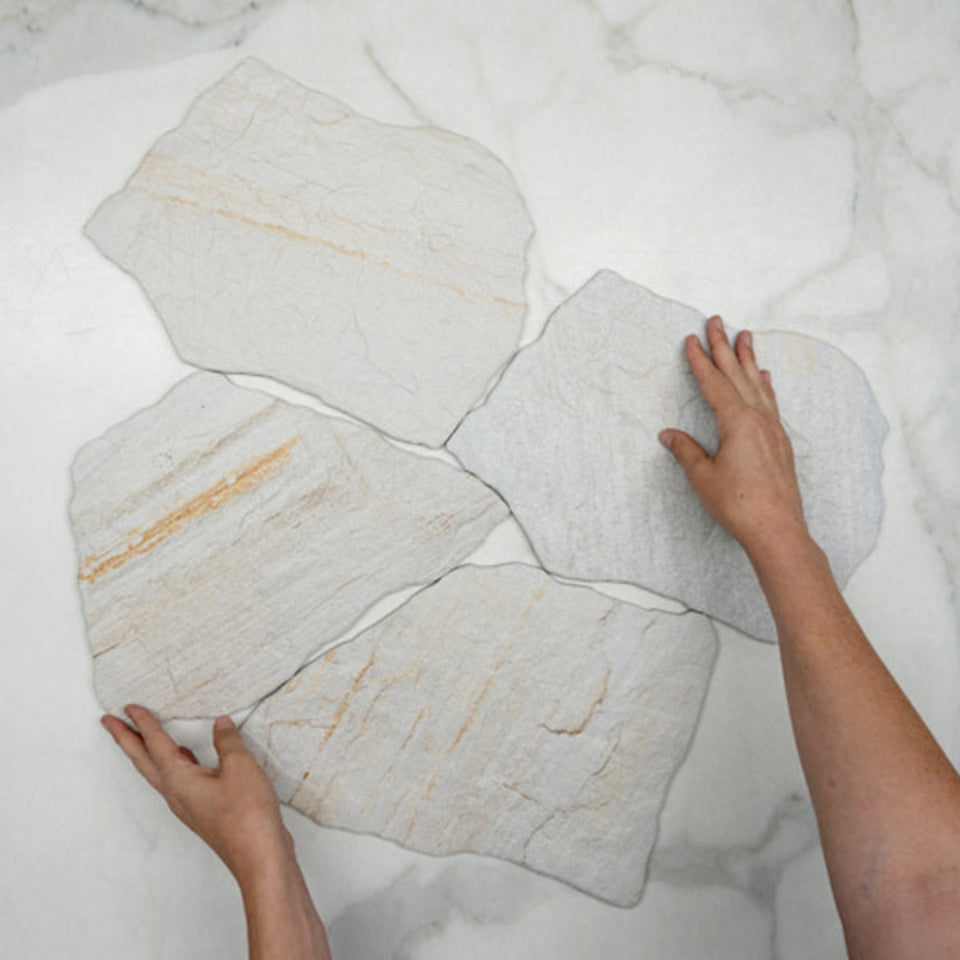
Crazy paving, also known as flagstone or random paving, breaks from the grid entirely: irregular pieces fit together like a large, stylish puzzle, with the grout lines between them becoming part of the overall pattern rather than a purely functional gap. The technique has genuine history, seen in old Roman roads and rustic European courtyards, where local stone offcuts were used practically rather than discarded, and it saw a particular resurgence in mid-20th-century garden patios before returning again to contemporary use.
The random, irregular shapes give a surface genuine energy, less rigid and predictable than standard tiling. In natural stone specifically, the material's inherent texture adds a further layer of connection to the outdoors, and because every installation lays out slightly differently, the finished surface is genuinely unique to that specific project.
Outdoor spaces, patios, courtyards, paths and pool surrounds, are the classic application, and many natural stones offer decent grip underfoot when correctly finished. Indoor floors, in living rooms, kitchens or a sunroom, can use crazy paving for a genuinely hard-wearing, characterful floor. Feature walls, around a fireplace, as a kitchen splashback, or within a bathroom, bring the same textured, organic quality to a vertical surface.
Durable stones like quartzite, slate and basalt hold up well to foot traffic and Australian weather conditions when installed and maintained correctly, giving a crazy pave surface genuine longevity when done properly.
Much natural stone crazy paving uses offcuts, the broken pieces left over when larger slabs are cut, making practical use of material that would otherwise go to waste.
Sandstone brings warm, earthy tones, beige, tan and occasional pink hues, with a naturally textured surface. It's porous, so sealing is genuinely important, particularly outdoors or in wet areas.
Slate has a distinctive layered appearance, often in deeper greys, greens, purples or black, and can split naturally along its grain, adding to its textured character.
Quartzite is exceptionally hard and long-lasting, often with a subtle crystalline sparkle, available in white, grey, yellow and pink tones. Its density gives it strong resistance to everyday wear.
Bluestone (basalt), a dense volcanic rock in dark grey or black, gives a strong, contemporary look and genuine durability.
Travertine, a form of limestone in creamy beige and tan shades, brings a classic, Mediterranean-leaning character. It carries small natural pits, typically filled in tile form, and needs sealing like other porous stones.
Marble offcuts, where available, give a genuinely luxurious white and grey veined pattern, though they need careful sealing and more ongoing attention than the more robust stone options.
Porcelain crazy pave tiles replicate the look convincingly while offering a few practical advantages. Pieces tend to be more uniform in thickness than natural stone offcuts, which simplifies laying. Porcelain also absorbs very little water, resisting stains without needing a sealer, which reduces ongoing maintenance considerably. Manufacturers can produce porcelain in colours and patterns not found in nature, and quality porcelain resists frost cracking reliably, making it a dependable choice for colder outdoor climates.
Choosing between natural stone and porcelain comes down to priority: genuine material authenticity and variation, or simpler installation and lower ongoing maintenance.
Grout choice matters more here than with standard tiling, since the joints are wide and become a genuine part of the design. A contrasting grout against the stone colour makes each individual piece stand out for a bold, graphic look, while a matching grout blends the pieces together, letting overall texture carry the visual interest instead. For bathrooms, laundries or outdoor applications, a quality mould- and water-resistant grout matters; Maxisil Grout is worth considering for dependable results.
Planning the layout carefully avoids a genuinely chaotic result despite the "crazy" name. Pieces should fit together reasonably evenly, with fairly consistent grout gaps, avoiding clusters of tiny offcuts or unintentional long, straight grout lines. A dry lay, arranging pieces on the ground without adhesive first, lets the pattern be adjusted before anything is permanently fixed.
Scale should relate to the size of the area being covered. Very large stone pieces can look disproportionate in a small courtyard, while very small pieces can look overly busy across a large living room floor. The right balance depends on the specific space.
Colour palette should work with the room or garden's existing materials. Warm tones, sandstone, some quartzites, beige or terracotta-leaning stone or porcelain, pair naturally with timber and other earthy materials. Cool tones, slate, bluestone, basalt and grey stones, suit a more modern design alongside metal finishes or cooler paint colours. For the boldest statement, black or white crazy paving, marble pieces or certain quartzites and porcelains, gives a strong graphic result.
Crazy paving is, by design, the opposite of a standard uniform tile size; its appeal comes entirely from that variation, which is what avoids the look of a plain, repeating grid.
Base preparation is the foundation of a lasting result. The substrate, whether indoor concrete or an outdoor base, needs to be clean, strong, level and stable. Outdoor installations often require excavating soil, laying compacted road base, and sometimes pouring a concrete slab; indoor installations need a level concrete floor or appropriate tile underlay. A poor base risks cracking or movement over time.
Adhesive selection should match the specific material and substrate. Natural stone is often heavier with an uneven back, generally requiring a thicker adhesive bed or a product formulated specifically for stone. Following the adhesive manufacturer's specific instructions matters more here than with standard tiling.
Laying takes considerably more time and care than uniform tiles, since each piece needs individual positioning to fit its neighbours while keeping grout gaps reasonably even. Because natural stone pieces vary in thickness, back-buttering, applying extra adhesive under thinner pieces, helps achieve a level final surface.
Grouting also takes longer, given the wider, irregular gaps. Grout needs to be pushed thoroughly into every gap for proper support and water resistance, then cleaned off the stone surface promptly before it sets, carefully enough not to disturb the placed pieces.
Sealing is essential for nearly all natural stone crazy paving. Sealers penetrate the stone and grout, protecting against staining, water damage and sun fading, applied once the grout has fully cured. The specific sealer needed depends on the stone type and the desired look, some purely protective, others deepening the stone's colour, and reapplication is generally needed every few years depending on the product and the area's use. Grout benefits from sealing too, and expansion joints around the edges should be properly sealed with a flexible product such as Maxisil Silicone.
A confident, experienced DIYer might tackle a small crazy pave project, but the combination of base preparation, handling heavy stone, achieving a level finish from uneven pieces, correct grouting and sealing makes this a genuinely involved job. Professional tilers bring both the equipment and the material-specific experience to manage these challenges reliably, generally the safer choice for anything beyond a small, low-stakes area.
Day-to-day cleaning is straightforward: a regular sweep removes loose debris, and a proper clean uses water with a stiff brush outdoors or a mop indoors. Harsh acidic or alkaline cleaners should be avoided on natural stone specifically, since they can damage the surface or strip the sealer; a gentle, pH-neutral cleaner formulated for stone or tile is the safer choice.
Spills and stains should be dealt with quickly, particularly on unsealed or porous stone. Blotting, rather than wiping, prevents a stain from spreading further. For a stubborn stain, a specific stone cleaner or poultice designed for the stone and stain type may be needed, and any new product is worth testing on a hidden area first.
Resealing natural stone periodically is necessary, with frequency depending on the stone, the sealer used, and how much wear the area sees. A simple check: drip a small amount of water on the surface; if it beads up, the sealer is still working, but if it soaks in quickly and darkens the stone, resealing is due.
Checking the grout periodically catches problems early. Stained grout can be treated with a specific grout cleaner, and any cracking or crumbling should be repaired promptly, since damaged grout lets water seep beneath the tiles, a common source of larger issues over time. Sealing the grout itself also helps prevent staining and mould.
Crazy paving, also known as flagstone paving, uses irregularly shaped pieces of natural stone laid in a random pattern rather than uniform shapes and straight lines, embracing asymmetry to create unique, organic-looking surfaces for patios, paths, pool surrounds, and sometimes walls.
Common choices include durable natural stones such as bluestone (basalt), limestone, travertine, sandstone, slate and quartzite. Each offers different colours, textures and durability levels, suited to different aesthetic finishes and applications.
Yes, provided the concrete base is structurally sound. This generally involves cleaning and preparing the concrete, then adhering the stone pieces with an adhesive or mortar mix designed specifically for stone. Thinner paving pieces, around 20mm, are often preferred for this method.
Maintenance is relatively straightforward: regular sweeping keeps debris off the surface, and periodic washing with water and a mild, pH-neutral cleaner removes general dirt buildup. Sealing the stone at installation, and resealing every few years depending on wear and stone type, is strongly recommended to protect against stains, moisture and weathering.
The joints are typically filled with grout or a sand-and-cement mortar mix, which locks the stones in place, limits movement, and helps suppress weed growth between pieces. Grout colour can be chosen to either contrast with or blend into the stone for a different overall effect.
Crazy paving is easiest to plan alongside the room or garden's broader material palette, since stone tone and grout colour should complement existing tiles, timber and fixtures rather than being chosen in isolation. Browse the full outdoor tiles and tiles collections for complementary formats and finishes to bring the complete project together.


